

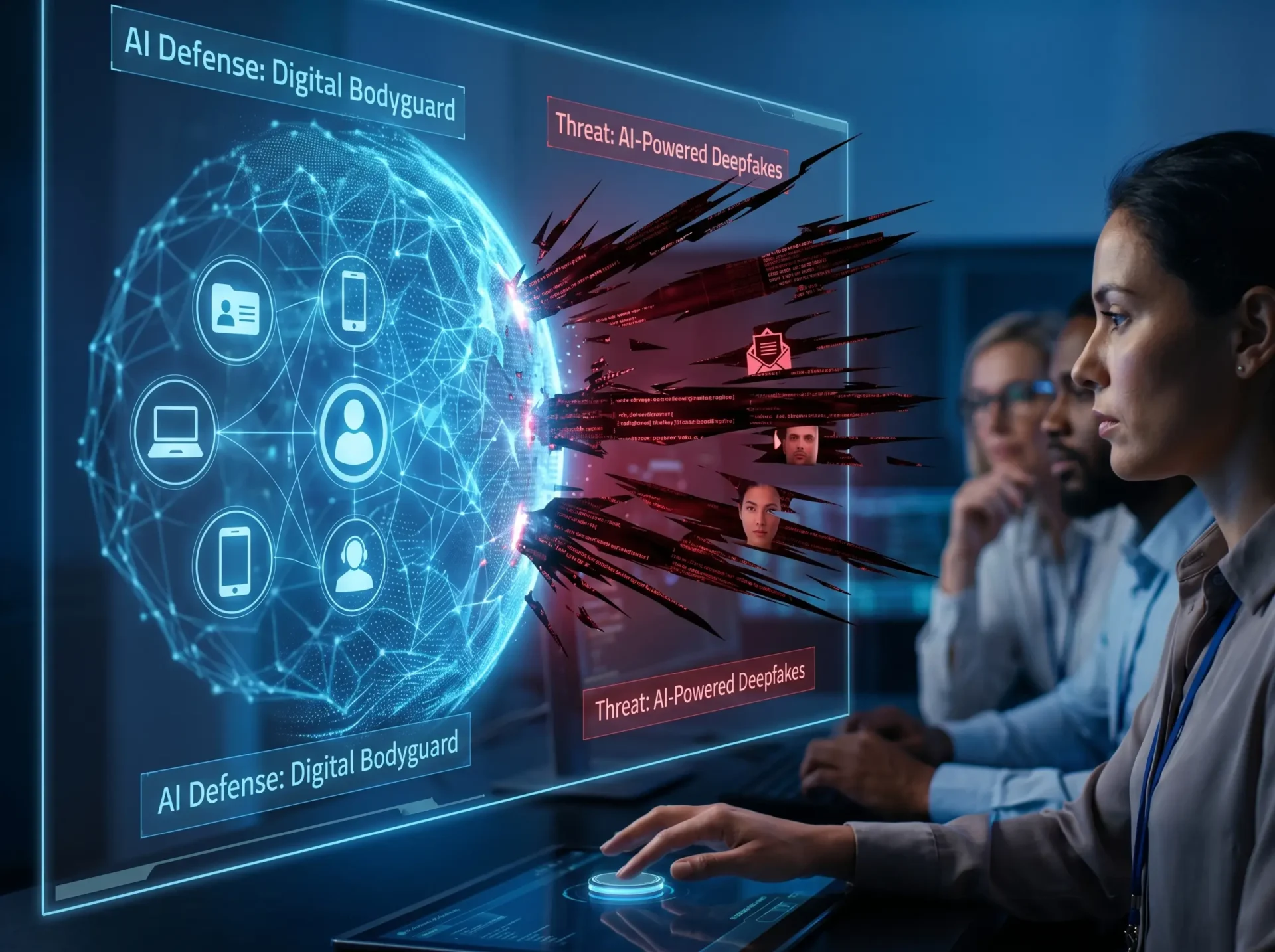
Let’s be real, we’re already living with AI every single day. Whether it’s your phone suggesting the next word in a text or Netflix knowing exactly which show you’ll binge-watch next, AI has moved into our lives without most of us even noticing. But there’s a much bigger, quieter move happening behind the scenes. AI is currently shaking up the world of cybersecurity in a way that makes traditional tools look like trying to catch a cat in the dark.
Here is the lowdown on how this digital ‘detective’ is changing the game, and why it actually matters to you.
AI is the Digital Bodyguard You Never Knew You Had!
Think of traditional security like a basic lock on your door. It works, but only if the burglar uses a key that you’ve seen before. AI-powered security is more like hiring a super-smart bodyguard who doesn’t just watch the door but learns exactly what’s ‘normal’ for you.
For example –
It’s lightning fast: AI-based systems can spot a cyberattack about 85% faster than traditional tools. In one simulation, AI detected a ransomware attack in just 12 seconds! A move that usually takes humans over 90 minutes to even notice.
It knows your habits: In banking, AI learns your typical spending patterns. If you suddenly try to send a huge chunk of money from a country you’ve never visited at 3 a.m., the AI flags it before the funds are even gone.
It cleans up the noise: Security teams used to get buried under thousands of alerts (most of which were false alarms). AI acts as a filter, clearing out the ‘noise’ so the human experts can focus on the real threats.
The Kicker: The Bad Guys Have AI Too
Here is the part where we need to stay sharp. Just like the good guys are using AI to protect us, hackers are using it to get sneakier. It’s a high-stakes game of digital cat and mouse.
Remember when you could spot a scam because of bad grammar or weird spelling? Those days are mostly over. AI can now write “perfect” phishing emails that sound exactly like a real co-worker or a legitimate company. Attackers even use “Evil AI” platforms like WormGPT to write malicious code in seconds or create deepfakes! In case you didn’t know, deepfakes are fake audio or video of a person that sounds or looks so real that, for a normal person, it’s almost impossible to figure out that they are, in fact, AI-generated. In this case, it can be your boss asking for an urgent wire transfer.
Why You Should Actually Care
You might think, “I’m not a big company, why does this matter to me?” But AI-driven attacks don’t just target big banks. They affect your email inbox, your smart home devices, and even your social media. Because AI can automate the boring parts of hacking, cybercriminals can now launch thousands of personalized attacks at once. What used to take a human hacker 16 hours to research now takes an AI about 5 minutes. This means attacks are becoming harder to see because they look like normal, everyday operations.
How to Stay One Step Ahead
The good news? You don’t need a computer science degree to stay safe. While the tech is getting more complex, the best defences are still pretty simple.
Don’t just trust the ‘look’: Since AI can mimic voices and writing styles, always verify high-risk requests (like sending money or passwords) through a second channel, like a quick phone call or a separate messaging app.
Use Multi-Factor Authentication (MFA): It’s one of the best ways to stop an attacker, even if they manage to ‘guess’ your password using AI.
Keep a human in the loop: AI is great, but it’s not perfect. It can sometimes over-collect data or miss context. We still need human eyes to make the final judgment calls.
The Big Picture: You & AI vs. The Bad Guys
Look, at the end of the day, we are in a high-stakes game of digital cat and mouse where the mouse is learning just as fast as the cat. While the tech might feel a bit intimidating, AI is no longer just an add-on; rather, it has become the backbone of how protection is done. The goal isn’t for machines to take over, but for them to be your ultimate digital sidekick.
While we are letting AI handle the heavy lifting, such as spotting patterns in billions of data points or catching a ransomware attack in 12 seconds instead of 90 minutes, we still need humans in the loop to provide context and make the final judgment calls. We’re moving toward a world of predictive security, where AI acts like a digital fortune-teller, sniffing out risks before they even reach your inbox. It’s about working at machine speed to catch threats 85% faster than traditional tools ever could.
The bottom line is, AI is no longer just a tool; it’s the new frontier of digital defence. By staying a little bit vigilant, verifying high-risk requests, and using these smarter tools, we can make sure the digital detective stays firmly on our side.
Stay sharp, stay secure, and welcome to the future of defence!
Author: Jahid Hasan Siddiqui, Senior Lecturer, Universal College Bangladesh (UCBD)