


Introduction
Every time you shop online, transfer money through a banking app, send a confidential email, or simply log in to your favorite social media platform, your personal information travels across the internet. Despite this information passing through countless devices and networks, it usually remains secure. Have you ever wondered what makes this possible?
The answer lies in cryptography, the science of protecting information from unauthorized access. While modern cryptography relies on sophisticated algorithms and computing techniques, one of its most powerful foundations comes from an area of mathematics that has fascinated scholars for more than two thousand years: prime numbers.
Prime numbers may appear to be simple mathematical objects studied in school, but they play a remarkable role in safeguarding billions of digital transactions every day. This article explores what prime numbers are, why they are essential in cryptography, and how they help secure our digital lives.
What Are Prime Numbers?
A prime number is a natural number greater than 1 that has exactly two distinct positive divisors: 1 and itself.
Some examples of prime numbers include:
2, 3, 5, 7, 11, 13, 17, 19, 23, 29
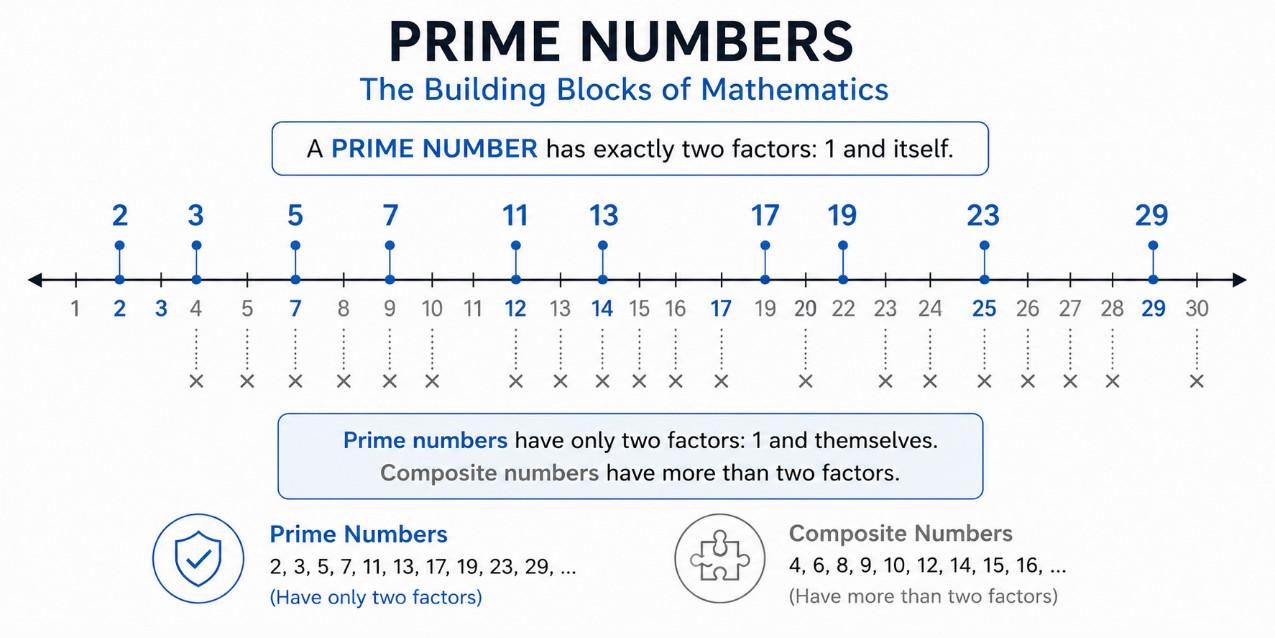 In contrast, numbers such as 4, 6, 8, 9, and 12 are called composite numbers because they can be expressed as the product of smaller integers. For example, 12 = 2 × 2 × 3, 15 = 3 × 5, 18 = 2 × 3 × 3.
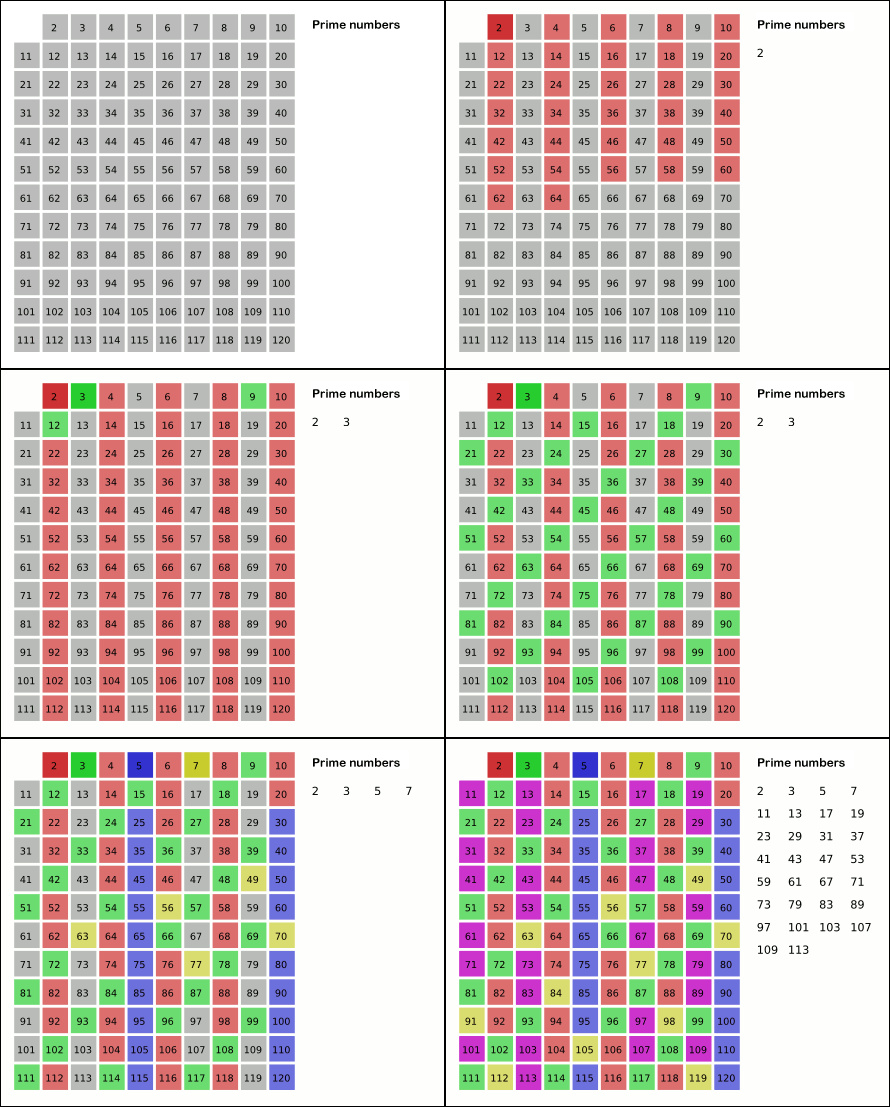
Sieve of Eratosthenes: algorithm steps for primes below 121 (including optimization of starting from prime’s square).
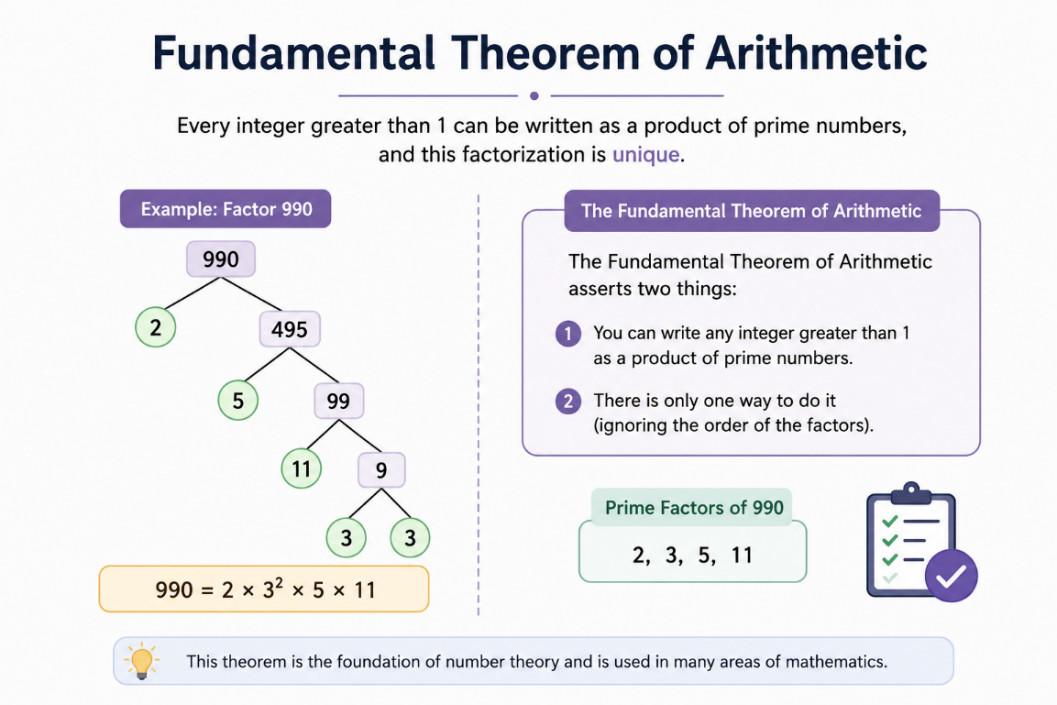
Prime numbers are often described as the “building blocks” of mathematics because every positive integer greater than 1 can be written uniquely as a product of prime numbers. This property, known as the Fundamental Theorem of Arithmetic, makes prime numbers indispensable in number theory and modern cryptography.
The Fundamental Theorem of Arithmetic, also known as the unique factorization theorem, states that every integer greater than 1 is either a prime number itself or can be represented as the product of prime numbers. This prime factorization is entirely unique, disregarding the order in which the factors are written.
For example, the number 12 can be factored into primes as 2×2×3, or simply 22×3. Regardless of the method you use to break down 12, you will always arrive at exactly two 2s and one 3.
Why Are Prime Numbers Special?
Prime numbers possess a fascinating characteristic that makes them ideal for cryptographic applications.
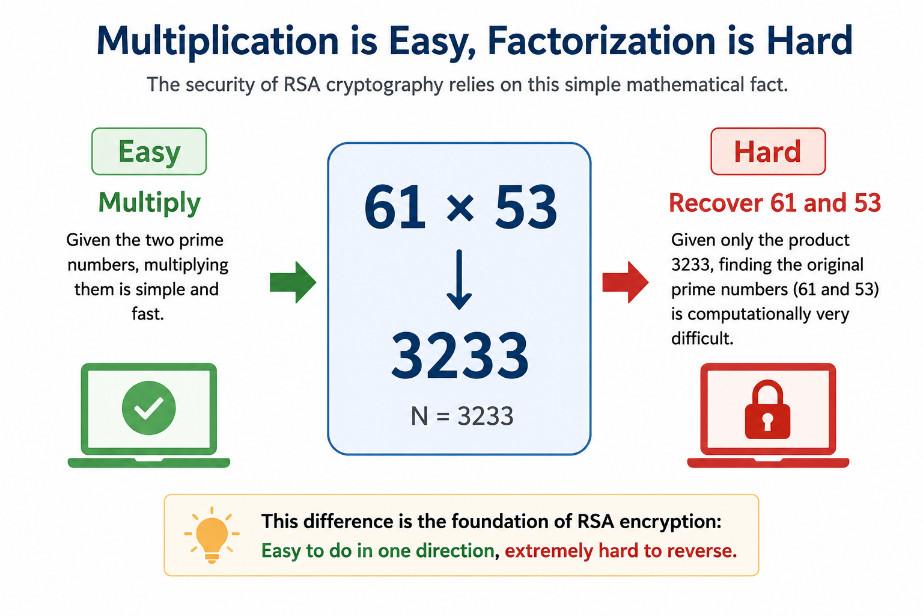 Multiplying two large prime numbers together is computationally straightforward. Even computers can perform this multiplication almost instantly. However, reversing the process is an entirely different story.
Suppose we multiply two large prime numbers: p × q = N
Finding the original values of p and q from the product N is called integer factorization. For sufficiently large values of N, this problem becomes extraordinarily difficult, even for powerful computers.
This imbalance between easy multiplication and difficult factorization forms the basis of many cryptographic systems. In computer science, such operations are often referred to as one-way functions because they are easy to compute but extremely difficult to reverse.
The Role of Prime Numbers in Cryptography
Every secure communication system aims to achieve four important goals: keeping information private (confidentiality), ensuring it is not altered (integrity), verifying identities (authentication), and preventing anyone from denying their actions (non-repudiation).
Prime numbers are central to achieving these objectives through public-key cryptography.
Unlike traditional symmetric encryption, where both sender and receiver share the same secret key, public-key cryptography uses two mathematically related keys:
- A public key, which anyone may know
- A private key, which only the owner possesses
Although these keys are mathematically connected, deriving the private key from the public key is computationally infeasible. This remarkable property is made possible through the mathematical behavior of large prime numbers.
How RSA Encryption Uses Prime Numbers
One of the most influential cryptographic algorithms is the RSA algorithm, introduced in 1977 by Ronald Rivest, Adi Shamir, and Leonard Adleman.
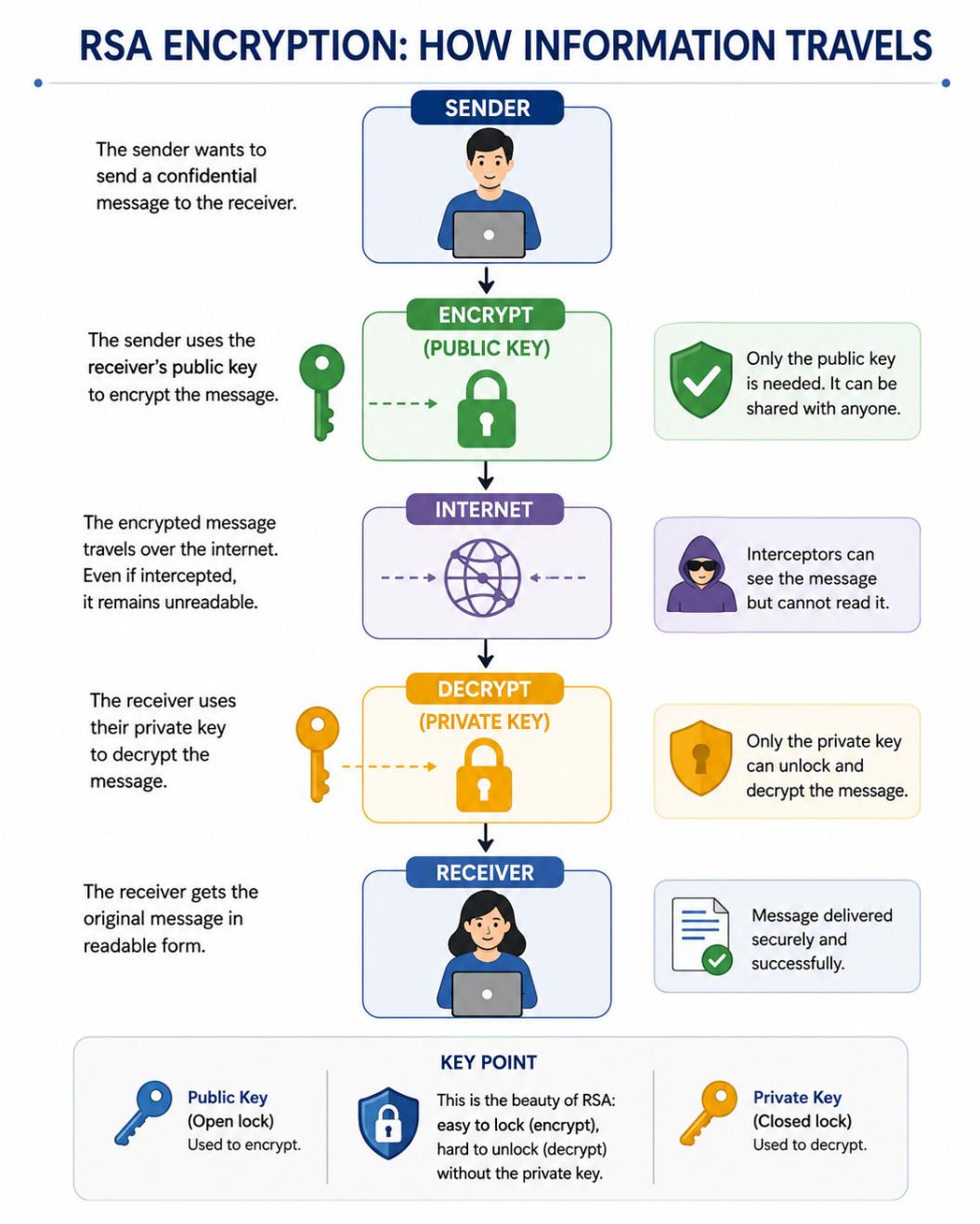
The simplified RSA process is as follows:
Step 1: Select Two Large Prime Numbers
Choose two large prime numbers: p and q
Modern implementations typically use prime numbers of hundreds or even thousands of bits long.
Step 2: Multiply Them
Compute: N = p × q
The value of N becomes part of the public key.
Step 3: Generate the Keys
Using additional mathematical operations involving Euler’s Totient Function, two keys are created:
- Public key
- Private key
The public key is openly distributed, while the private key remains secret.
Step 4: Encrypt the Message
Anyone wishing to send confidential information encrypts the message using the public key.
Step 5: Decrypt the Message
Only the private key can correctly decrypt the encrypted message.
Because discovering the private key would require factoring an extremely large integer, unauthorized users cannot practically recover the original message.
Everyday Applications of Prime Number Cryptography
Although most people never notice it, prime number cryptography operates behind the scenes in numerous digital services.
Online Banking
Whenever you log into your online banking portal, encryption protects your passwords, account information, and financial transactions.
E-commerce
Online shopping platforms encrypt payment details to prevent cybercriminals from intercepting sensitive information.
Secure Websites
The padlock icon displayed in a web browser indicates that encryption protocols are protecting communication between your device and the website.
Digital Signatures
Governments, universities, and organizations use digital signatures to verify the authenticity of electronic documents and certificates.
Secure Email
Many secure email systems use public-key encryption to ensure that only the intended recipient can read confidential messages.
Messaging Applications
Encrypted messaging services employ advanced cryptographic techniques to safeguard conversations from unauthorized access.
Cryptocurrencies
Many blockchain technologies rely heavily on public-key cryptography to verify ownership and authorize digital transactions securely.

Why Is RSA So Difficult to Break?
The security of RSA does not depend on keeping the algorithm secret. In fact, the RSA algorithm is publicly known. Instead, its security relies entirely on the computational difficulty of factoring extremely large integers.
For small numbers, factorization is easy. For example, 221 = 13 × 17
However, when the product contains hundreds or thousands of binary digits, no efficient classical algorithm is known that can factor such numbers within a practical timeframe.
As computing power increases, cryptographic standards adapt by recommending larger key sizes. Today, RSA implementations commonly use 2048-bit or 4096-bit keys, providing strong protection against classical attacks.
The Quantum Computing Challenge
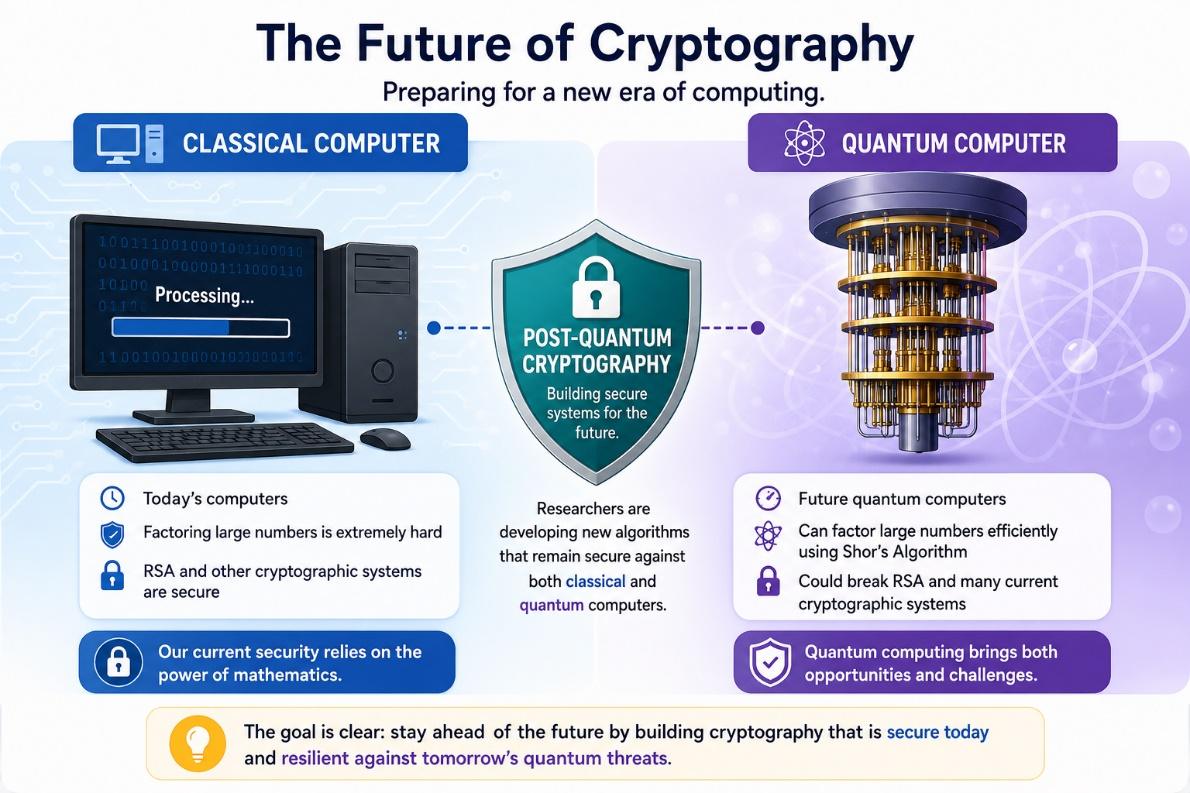
While current cryptographic systems remain secure against classical computers, researchers are preparing for the emergence of large-scale quantum computers.
Quantum algorithms, most notably Shor’s Algorithm, have demonstrated that sufficiently powerful quantum computers could efficiently factor large integers. If such machines become practical, many existing public-key cryptographic systems, including RSA, could become vulnerable.
To address this future challenge, researchers worldwide are developing post-quantum cryptography – new cryptographic algorithms designed to resist attacks from both classical and quantum computers.
The transition to post-quantum standards is already underway, ensuring that digital security remains robust in the decades ahead.
Fascinating Facts About Prime Numbers
Prime numbers continue to intrigue mathematicians and computer scientists alike.
- There are infinitely many prime numbers, a fact first proved by the ancient Greek mathematician Euclid over 2,300 years ago.
- The search for increasingly larger prime numbers remains an active area of mathematical research.
- Some of the largest known prime numbers contain tens of millions of digits.
- Prime numbers are essential not only in cryptography but also in coding theory, error correction, random number generation, and computational mathematics.
These remarkable numbers continue to bridge pure mathematics and practical technology.
Conclusion
Prime numbers remind us that even the most abstract mathematical ideas can shape the modern world in profound ways. Every time we transfer money, shop online, send a confidential email, or access cloud services, sophisticated cryptographic systems quietly protect our information – systems whose security rests on the unique properties of prime numbers. As technology advances toward the era of quantum computing, mathematics will continue to drive the next generation of secure communication. In many ways, the future of cybersecurity will remain a story written in numbers.
The next time you see the padlock icon in your web browser or complete a secure online payment, remember that behind the scenes, a simple concept from elementary mathematics is quietly helping to keep your digital world safe.
Author: Md. Kawsar Ahmed Asif, Lecturer, Department of Mathematics and Statistics
References
- Rivest, R. L., Shamir, A., & Adleman, L. (1978). A Method for Obtaining Digital Signatures and Public-Key Cryptosystems. Communications of the ACM, 21(2), 120–126.
- Stallings, W. (2017). Cryptography and Network Security: Principles and Practice (7th ed.). Pearson.
- Katz, J., & Lindell, Y. (2020). Introduction to Modern Cryptography (3rd ed.). CRC Press.
- Menezes, A. J., van Oorschot, P. C., & Vanstone, S. A. (1996). Handbook of Applied Cryptography. CRC Press.
- National Institute of Standards and Technology (NIST). Post-Quantum Cryptography Standardization Project.