

Nuclear Power Plant in Bangladesh: Opportunities and Challenges

Introduction Bangladesh has achieved a significant improvement in economic growth over the past two decades. It happened due to industrialization and urbanization processes as well as increased living standards. Nuclear power is one of the crucial sources to meet the growing demand for electricity in Bangladesh. Industries, households, health, education, media, and transport increasingly rely on the constant supply of energy. Although Bangladesh has greatly progressed in terms of electricity access, the issue of reliable and affordable energy remains a matter of great concern. Natural gas has so far been the most used source of energy. However, given the insufficient gas reserves, Bangladesh is now highly dependent on LNG, coal, and petroleum imports. This makes the country vulnerable to price changes in the world market. Electricity generation from renewable sources is increasing. Considering the intermittent nature of these resources, nuclear power may serve as the best stable electricity source for Bangladesh. Being Bangladesh’s first-ever nuclear power plant, Rooppur Nuclear Power Plant plays a vital role in ensuring electricity security while contributing to the sustainable development of the country. Nevertheless, nuclear power comes with several challenges that should be taken into account. This article will discuss both opportunities and threats of nuclear power in Bangladesh, as well as its overall impact on the country. LNG Wind Energy Solar Energy Coal The Rooppur Nuclear Power Plant Rooppur Nuclear Power Plant located in Ishwardi, Pabna is the biggest and the most ambitious project ever undertaken in Bangladesh. Rooppur Nuclear Power Plant was constructed under the Russian government’s technical and financial support, and it has two VVER-1200 (Generation III+) reactors capable of producing approximately 1,200 MW of electricity each. Once fully operational, the nuclear power station is estimated to provide nearly 2,400 MW of electricity to Bangladesh’s power grid. VVER-1200 Reactor Apart from covering the country’s energy needs, the nuclear power plant project also creates job opportunities and promotes infrastructure development. It also promotes technical education in Bangladesh, as the country’s universities are now preparing specialists in various fields of nuclear engineering. In addition, Rooppur Nuclear Power Plant will play a crucial role in advancing Bangladesh’s science, technology, education, and innovation capabilities. Rooppur Nuclear Power Plant Why Bangladesh Chose Nuclear Energy Bangladesh’s decision to embrace nuclear energy was motivated by multiple factors, including the possibility to produce electricity with fuel that is capable of continuous, stable power generation independent from weather conditions, as well as the fact that nuclear fuel is highly efficient and can yield enormous amounts of energy despite being compact and lightweight. In addition, nuclear energy production is associated with low greenhouse gas emissions, which aligns with global efforts to combat climate change; the project also promotes technological development, education, and innovation in Bangladesh. Opportunities Offered by Nuclear Power Nuclear power presents multiple opportunities for Bangladesh as an energy source that can ensure electricity security for the country. (i) Energy Security Nuclear energy production can help Bangladesh ensure electricity security as the natural gas reserves in the country are depleting, while the supply of other fossil fuels is unstable and subject to price variations on the world market. Nuclear reactors are capable of providing a continuous and stable electricity supply due to their ability to operate for a prolonged period of time without interruptions. In addition, a nuclear power plant is a reliable source of baseload power, which helps the country diversify its energy production and reduce its reliance on fossil fuels. (ii) Economic Growth Nuclear power can also promote Bangladesh’s economic growth by creating job opportunities and stimulating the development of new industries. Electricity is currently one of the most crucial inputs for most industries; hence, improved access to it will allow Bangladesh to increase its industrialization rates, which will lead to higher productivity, economic growth, and improved living standards. Besides, reliable electricity supply can also support the work of different social and business sectors, including healthcare and education. (iii) Environmental Benefits Nuclear energy production is associated with low greenhouse gas emissions, which presents a major opportunity for Bangladesh to achieve its climate goals and reduce the impact of energy production on the environment. Nuclear energy is a clean source of electricity compared to other energy sources available in Bangladesh. Although constructing nuclear power plants and processing nuclear fuel can be associated with increased carbon emissions, the overall impact on the environment can be limited compared to coal, oil, and natural gas power plants. Apart from that, nuclear energy can serve as a reliable electricity source for Bangladesh, which will reduce the carbon footprint of the energy sector. (iv) Complementing Renewable Energy Nuclear energy can complement the use of renewable energy sources, serving as a stable electricity source when the production of clean energy from wind turbines and solar panels is limited due to adverse weather conditions. This opportunity can be instrumental in meeting Bangladesh’s growing electricity demand while still relying on renewable energy sources. (v) Human Resource and Technological Development Developing a nuclear energy program has the potential to create significant opportunities for Bangladesh in terms of human resource development, technological progress, and access to new expertise. First, operating a nuclear power plant will require highly qualified specialists in diverse fields, and hence nuclear energy can become an important driver of Bangladesh’s education and technical development. Bangladesh’s nuclear energy development can also contribute to the creation of a competitive workforce in nuclear engineering and other STEM fields, as well as promote the growth of local engineering and technical universities. Moreover, nuclear energy can also offer research and innovation opportunities to Bangladeshi specialists in physics, environmental science, and other areas. As the new field of nuclear engineering develops in Bangladesh, it can also have a positive effect on the development of other industries and the country’s overall technological advancement. Challenges Facing Nuclear Power Although nuclear power offers many opportunities, it also comes with a set of significant challenges that Bangladesh will have to address carefully in order to realize the benefits of nuclear energy. (i) High Costs The
Importance of Human-Computer Interaction (HCI)

Human-Computer Interaction (HCI) is the study and design of the interaction between humans and computer systems. It focuses on creating technologies that are easy, efficient, and enjoyable for people to use. As computers have become an integral part of daily life, HCI has gained significant importance. From smartphones and laptops to automated machines and smart home devices, people constantly interact with technology. HCI ensures that these interactions are smooth, productive, and user-friendly. Why Good Design Matters: Lessons from Everyday Objects The importance of HCI can be understood by observing the design of everyday objects around us. Consider a knife used to cut a cucumber. A knife is designed with a sharp blade for cutting and a handle made of wood, plastic, or rubber for holding it safely. If the entire knife were sharp, it would be dangerous to use. The handle provides comfort, safety, and control, making the cutting process easier and more effective. Similarly, a steering wheel in a car is designed in a circular shape that allows the driver to control the movement of the vehicle with ease. The steering wheel serves as an interface between the driver and the wheels of the car. Without it, controlling the vehicle would be extremely difficult. These examples demonstrate how proper design enables efficient interaction between humans and tools. Bridging the Gap Between Humans and Computers In the same way, HCI focuses on providing appropriate interfaces that allow humans to interact effectively with computers. Humans and computers operate in very different ways. Computers process information through electronic signals and machine instructions, whereas humans communicate through language, speech, touch, vision, and physical movements. Therefore, an interface is needed to bridge this gap. Input devices such as keyboards, mice, touchscreens, microphones, and cameras help users send commands to computers, while output devices such as monitors, speakers, and printers provide feedback and results to users. A simple example of HCI can be seen when a person types a document in Microsoft Word. The keyboard allows the user to enter text, and the monitor displays the typed content instantly. This immediate feedback helps the user verify whether the correct keys have been pressed and whether the desired text has appeared on the screen. Without such interaction mechanisms, using computers would be complicated and inconvenient. Therefore, HCI plays a crucial role in making computer systems practical and accessible to users. Making Technology Easier to Use One of the primary objectives of HCI is to improve usability. Usability refers to how easy and effective a system is for users. A well-designed system should be easy to learn, simple to use, and capable of helping users complete tasks with minimal effort. For example, modern smartphone applications are developed with clear icons, simple menus, and intuitive navigation. These design choices allow even first-time users to operate applications without extensive training. By improving usability, HCI reduces user frustration and increases productivity. Another important aspect of HCI is efficiency. Efficient interfaces enable users to perform tasks quickly and accurately. For instance, keyboard shortcuts such as Ctrl+C and Ctrl+V allow users to copy and paste information much faster than navigating through multiple menus. Similarly, graphical user interfaces (GUIs) provide visual elements such as buttons, icons, and menus that simplify interaction. By reducing the time and effort required to perform tasks, HCI contributes to greater efficiency in personal, educational, and professional environments. HCI also enhances accessibility. Not all users have the same physical abilities, knowledge, or experience with technology. Some individuals may have visual impairments, hearing difficulties, or mobility limitations. HCI helps designers create systems that accommodate diverse user needs. Examples include screen readers for visually impaired users, voice recognition systems for individuals who cannot type, subtitles for hearing-impaired users, and touch-based interfaces for users with limited motor skills. Through accessibility features, HCI ensures that technology can be used by a wider population. From Keyboards to Voice Assistants: The Evolution of Interaction Over the years, numerous interaction methods have been developed. Traditional input devices such as keyboards and mice are now accompanied by touchscreens, voice assistants, gesture-recognition systems, eye-tracking technology, and virtual reality environments. Voice assistants like Siri, Google Assistant, and Alexa allow users to interact with computers through natural speech. Touchscreens have revolutionized the use of smartphones and tablets, making interaction more direct and intuitive. Gesture and gaze-based technologies are particularly useful in specialized environments, such as healthcare and assistive technology. These innovations are the result of continuous research and development in HCI. Despite these advancements, the keyboard remains one of the most widely used interaction devices. This is because typing is fast, accurate, and efficient for creating documents, emails, reports, and other textual content. Most users learn keyboard skills from an early age, making it a familiar and reliable medium of interaction. Alternative methods such as voice, gesture, and gaze-based interaction offer convenience in certain situations but often require additional attention, specialized equipment, or favorable environmental conditions. As a result, keyboards continue to be a preferred choice for many tasks. Preventing Mistakes and Improving Safety HCI is also important because it reduces errors and improves safety. In critical systems such as medical equipment, aircraft controls, and industrial machinery, poorly designed interfaces can lead to serious mistakes and accidents. HCI principles help designers create systems that provide clear instructions, meaningful feedback, and error-prevention mechanisms. By minimizing confusion and mistakes, HCI contributes to the safe operation of technology in high-risk environments. Furthermore, HCI increases user satisfaction. People prefer technologies that are easy, enjoyable, and comfortable to use. Applications with attractive designs, responsive interfaces, and intuitive controls create positive user experiences. Organizations therefore invest heavily in HCI research and user-centered design to attract and retain customers. A good user experience often determines the success or failure of a product in the marketplace. In conclusion Human-Computer Interaction is a vital field that bridges the gap between humans and technology. Just as tools like knives and steering wheels are designed to facilitate effective interaction, computer interfaces are designed to help users communicate with digital systems
Prime Numbers in Cryptography: How Mathematics Secures Digital Transactions

Introduction Every time you shop online, transfer money through a banking app, send a confidential email, or simply log in to your favorite social media platform, your personal information travels across the internet. Despite this information passing through countless devices and networks, it usually remains secure. Have you ever wondered what makes this possible? The answer lies in cryptography, the science of protecting information from unauthorized access. While modern cryptography relies on sophisticated algorithms and computing techniques, one of its most powerful foundations comes from an area of mathematics that has fascinated scholars for more than two thousand years: prime numbers. Prime numbers may appear to be simple mathematical objects studied in school, but they play a remarkable role in safeguarding billions of digital transactions every day. This article explores what prime numbers are, why they are essential in cryptography, and how they help secure our digital lives. What Are Prime Numbers? A prime number is a natural number greater than 1 that has exactly two distinct positive divisors: 1 and itself. Some examples of prime numbers include: 2, 3, 5, 7, 11, 13, 17, 19, 23, 29 In contrast, numbers such as 4, 6, 8, 9, and 12 are called composite numbers because they can be expressed as the product of smaller integers. For example, 12 = 2 × 2 × 3, 15 = 3 × 5, 18 = 2 × 3 × 3. Sieve of Eratosthenes: algorithm steps for primes below 121 (including optimization of starting from prime’s square). Prime numbers are often described as the “building blocks” of mathematics because every positive integer greater than 1 can be written uniquely as a product of prime numbers. This property, known as the Fundamental Theorem of Arithmetic, makes prime numbers indispensable in number theory and modern cryptography. The Fundamental Theorem of Arithmetic, also known as the unique factorization theorem, states that every integer greater than 1 is either a prime number itself or can be represented as the product of prime numbers. This prime factorization is entirely unique, disregarding the order in which the factors are written. For example, the number 12 can be factored into primes as 2×2×3, or simply 22×3. Regardless of the method you use to break down 12, you will always arrive at exactly two 2s and one 3. Why Are Prime Numbers Special? Prime numbers possess a fascinating characteristic that makes them ideal for cryptographic applications. Multiplying two large prime numbers together is computationally straightforward. Even computers can perform this multiplication almost instantly. However, reversing the process is an entirely different story. Suppose we multiply two large prime numbers: p × q = N Finding the original values of p and q from the product N is called integer factorization. For sufficiently large values of N, this problem becomes extraordinarily difficult, even for powerful computers. This imbalance between easy multiplication and difficult factorization forms the basis of many cryptographic systems. In computer science, such operations are often referred to as one-way functions because they are easy to compute but extremely difficult to reverse. The Role of Prime Numbers in Cryptography Every secure communication system aims to achieve four important goals: keeping information private (confidentiality), ensuring it is not altered (integrity), verifying identities (authentication), and preventing anyone from denying their actions (non-repudiation). Prime numbers are central to achieving these objectives through public-key cryptography. Unlike traditional symmetric encryption, where both sender and receiver share the same secret key, public-key cryptography uses two mathematically related keys: A public key, which anyone may know A private key, which only the owner possesses Although these keys are mathematically connected, deriving the private key from the public key is computationally infeasible. This remarkable property is made possible through the mathematical behavior of large prime numbers. How RSA Encryption Uses Prime Numbers One of the most influential cryptographic algorithms is the RSA algorithm, introduced in 1977 by Ronald Rivest, Adi Shamir, and Leonard Adleman. The simplified RSA process is as follows: Step 1: Select Two Large Prime Numbers Choose two large prime numbers: p and q Modern implementations typically use prime numbers of hundreds or even thousands of bits long. Step 2: Multiply Them Compute: N = p × q The value of N becomes part of the public key. Step 3: Generate the Keys Using additional mathematical operations involving Euler’s Totient Function, two keys are created: Public key Private key The public key is openly distributed, while the private key remains secret. Step 4: Encrypt the Message Anyone wishing to send confidential information encrypts the message using the public key. Step 5: Decrypt the Message Only the private key can correctly decrypt the encrypted message. Because discovering the private key would require factoring an extremely large integer, unauthorized users cannot practically recover the original message. Everyday Applications of Prime Number Cryptography Although most people never notice it, prime number cryptography operates behind the scenes in numerous digital services. Online Banking Whenever you log into your online banking portal, encryption protects your passwords, account information, and financial transactions. E-commerce Online shopping platforms encrypt payment details to prevent cybercriminals from intercepting sensitive information. Secure Websites The padlock icon displayed in a web browser indicates that encryption protocols are protecting communication between your device and the website. Digital Signatures Governments, universities, and organizations use digital signatures to verify the authenticity of electronic documents and certificates. Secure Email Many secure email systems use public-key encryption to ensure that only the intended recipient can read confidential messages. Messaging Applications Encrypted messaging services employ advanced cryptographic techniques to safeguard conversations from unauthorized access. Cryptocurrencies Many blockchain technologies rely heavily on public-key cryptography to verify ownership and authorize digital transactions securely. Why Is RSA So Difficult to Break? The security of RSA does not depend on keeping the algorithm secret. In fact, the RSA algorithm is publicly known. Instead, its security relies entirely on the computational difficulty of factoring extremely large integers. For small numbers, factorization is easy. For example, 221 = 13 × 17 However,
The Hidden Mathematics Behind Social Media Algorithms

A significant aspect of modern living is social media. We are instantly presented with posts, videos, advertisements, and recommendations on Facebook, Instagram, TikTok, YouTube, and others many of which appear remarkably relevant to our interests. Many believe that this occurs accidentally or just because the software knows them. Every scroll, click, like, and share is actually driven by a strong force that is mathematics. 1. Gathering Information: Putting Behavior into Numbers On social media, every activity generates data. The program logs user actions like as liking a picture, watching a video through to the finish, leaving comments on a post, following a page, or even pausing briefly when scrolling. These behaviors are transformed into quantifiable values. For example, a platform might monitor: The duration of a user’s video viewing The kinds of content they enjoy the most which accounts they frequently communicate with The subjects they look up How often they share their stuff Numerical data is created from this information above. In order for the algorithm to identify pattern in user behavior mathematics aids in the organization an analysis of these numbers. 2. Probability: Forecasting Your Preferences Probability is one of the most significant areas of mathematics utilized in social media algorithms. Platforms employ probability to determine the likelihood that a user will interact with a specific piece of content. Assume, for instance, that a consumer seldom views sports content but frequently enjoys cookery videos. The likelihood that a viewer will interact with another cookery video is significantly higher than the likelihood that they will enjoy a football video, according to the algorithm. The platform will prioritize cooking related material in the stream based on this forecast. Algorithms, put simply, pose queries such as: How likely is it that the user will click on this post? What is the probability that they will watch this movie for more than ten seconds? What is the likelihood that they will reply, share, or comment? Typically, the content that is most likely to be engaged with is displayed first. 3. Statistics: Discovering Trends in Human Behavior In order to comprehend millions of users simultaneously, social media firms rely heavily on statistics. Platforms are able to find patterns and common behaviors by analyzing vast amounts of data. For example, statistics can be used to address queries like: What kind of post receives the most attention during a specific time of day? Which age group is most likely to watch quick videos? How frequently do users utilize the app again after getting alerts? What subjects are popular in a particular nation or area? Using averages, percentages, correlations, and distributions, social media companies can make well informed decisions on the kind of content that should be promoted. 4. Ranking Systems: Deciding What Appears First When you open a social media app, your feed is somewhat different from your parents news feed, which displays all of the posts in a random order. Rather, quantitative scoring techniques are used by the platform to rank content. A score is assigned to each post depending on various criteria, including popularity, relevancy, freshness, and the user’s past activity. A basic scoring formula could resemble this: Content Score = Interest + Popularity + Recency + Relationship Strength This implies that a post can show up higher in your feed if It aligns with your interests, It has already gotten a lot of likes and comments. It was just posted, It originates from a person you frequently communicate with. Although real social media formulas are much more complex, the basic idea is the same: mathematics is used to assign scores, compare content, and rank what should be shown first. 5. Machine Learning: Teaching Algorithms to Improve Machine learning, a discipline that blends statistics, computer science, and mathematics, is used by contemporary social media platforms. By learning from user behavior, machine learning enables algorithms to get better over time. For instance, the program detects a shift when a user abruptly begins watching videos about gardening. It starts suggesting more gardening related stuff and changes its forecasts. This is made feasible by the fact that mathematical models are always adapting to new information. Machine learning, ideas like these are frequently used: linear algebra, probability distributions, optimization, regression models, pattern recognition. Algorithms are assisted by these mathematical tools in learning which content is most likely to maintain user attention. 6. Graph Theory: Mapping Social Connections Graph theory is another secret mathematical concept that underlies social media. A graph is a mathematical structure composed of nodes and links. Users can be viewed as nodes on social media, while connections are made through friendships, likes, follows, and conversations. Graph theory aids platforms in comprehending: Who is associated with whom Which users are influential The sharing of data through a network Which communities have comparable interests? For this reason, you can start seeing that material if a number of your friends like a page or follow a creator. The network’s mathematical relationships are used by the platform to recommend pertinent content. 7. Optimization: Maximizing Engagement The goal of social media is to increase user engagement. This is the point at which optimization mathematics becomes crucial. Finding the optimal option among a variety of options is the process of optimization. The best result for social media platforms could be: users are spending more time on the app, displaying advertisements that people are likely to click on, suggesting information that encourages individuals to be active, lowering the likelihood that users may quit the platform. The algorithm uses mathematical optimization to select the strategy that generates the maximum level of engagement after testing several approaches. 8. The Human Side of the Numbers Social media algorithms have remarkable mathematical foundations, but they also pose significant challenges. Algorithms may occasionally promote compulsive scrolling, emotional responses, or the dissemination of sensational content if they are intended to keep users online longer. Although mathematics is neutral in and of itself, its application can have a significant impact on society. This implies that comprehending social media algorithms is a social and ethical problem in addition to a technological one.
Why cybersecurity expertise makes a great career

Bangladesh’s rapid shift toward a digital-first economy, driven by mobile banking, e-commerce, and cloud adoption, has made cybersecurity not just important, but indispensable. Everyone’s personal information, financial transactions and work lives are now increasingly dependent on digital systems, which means the need to protect data from cyberattacks has become more important than ever Bangladesh’s rapid shift toward a digital-first economy, driven by mobile banking, e-commerce, and cloud adoption, has made cybersecurity not just important, but indispensable. Everyone’s personal information, financial transactions and work lives are now increasingly dependent on digital systems, which means the need to protect data from cyberattacks has become more important than ever. Naturally, the need for professional cybersecurity experts has risen significantly due to this continuously expanding digital transformation, not just in Bangladesh, but across the globe too. That is why cybersecurity has become so crucial as a career field. Cybersecurity professionals are the ones who stand between hackers and regular people, protecting their sensitive information and keeping the whole digital infrastructure secure. With a great number of cyber threats growing every day, the need for skilled cybersecurity experts has also been growing, not just in Bangladesh, but all around the world. What’s great about having cybersecurity as a career is the many possibilities exist. Some people become ethical hackers who try to break into systems deliberately in order to identify potential threats and fix them. Others go into digital forensics where they get to investigate cybercrimes and trace the attacks Even though there is an evident rising demand, there aren’t nearly enough of cybersecurity professionals in Bangladesh. A survey conducted last year by Bangladesh Institute of Bank Management portrayed that, 70 per cent of surveyed banks have no automation. One of the primary reasons behind this scenario is that, most organisations in the country still depend on people who only have basic training. If not that, they rely on outsourced help to handle their data security. The reason behind this is very simple. There just are not enough formal and internationally recognized programs in Bangladesh which can train people properly. That is something that really needs to change. Institutions are beginning to address this gap by offering up-to-date programs. Such academic programs are designed to align with international standards. Programs like these are essential for developing a skilled cybersecurity workforce in Bangladesh. What’s great about having cybersecurity as a career is the many possibilities exist. Some people become ethical hackers who try to break into systems deliberately in order to identify potential threats and fix them. Others go into digital forensics where they get to investigate cybercrimes and trace the attacks. Then there are the security analysts, risk assessors, cryptographers, and the list goes on. The different options allow individuals to choose the career path that they like better. Be it problem solving, technical challenges or strategic planning, there is something for everyone. Interestingly, it’s not limited to only one industry either. Banks need cybersecurity experts and so do hospitals, government offices, tech startups, and multinational corporations. Because threats are global, the work opportunities are too, including the chance to work abroad. The US Bureau of Labor Statistics (BLS) predicts 33 percent job growth between 2023 and 2033, much faster than the average across all occupations. The field offers secure careers with well-paying jobs, and there’s always something new to learn. In addition to technical expertise, cybersecurity professionals need to be ethical, flexible and critical thinkers. Technology changes fast, and so do the threats. Cybersecurity programs such as the one developed by the University of Lancashire, that is offered through Universal College Bangladesh (UCBD), try to prepare students for that reality by combining classroom learning with real, hands-on experience. On a whole, cybersecurity is not only a technical career. It’s a profession with a purpose. It gives people the chance to protect individuals, organisations, and society in the digital world. For students passionate about technology, problem-solving, and global opportunities, a career in cybersecurity can be both rewarding and impactful. * Ambreen Zaman is a senior lecturer at Universal College Bangladesh * The views expressed here are the author’s own. Published In: Prothom Alo
Top Skills You Need to Build a Successful Career in AI and Data Science
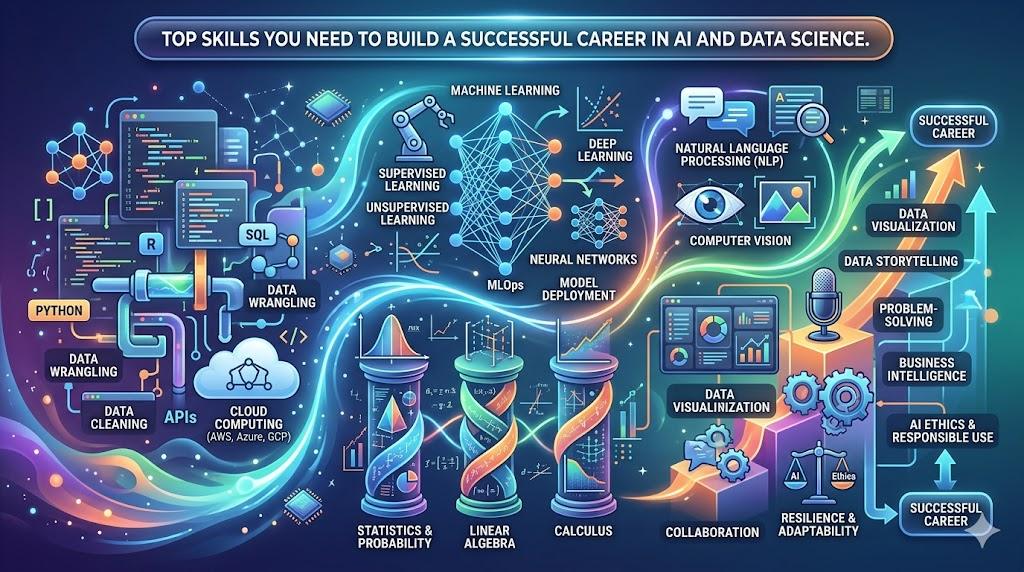
Author: Rajan Ahmad Artificial Intelligence (AI) and Data Science cease to be a far-off buzzword. They are now changing industries, and transforming businesses, and providing thousands of career opportunities to the world. Healthcare, financial, entertainment, education, and other companies are employing AI-based solutions to ensure they become more efficient, automate processes, and make smarter decisions. This has led to a frenzy by employers to seek personnel with technical skills, in addition to innovative problem-solving skills. Whether you are a student, a dilettante in technology, or you are going to switch careers, every person can acquire the proper AI and data science abilities and unlock the door to fruitful opportunities. Why AI and Data Science Skills Matter The profession of AI specialists is growing due to the turn of businesses to individuals who can operate with intelligent technologies and data-oriented systems. These skills come in handy since they: Automate manual activities and improve productivity. Help companies to make the right predictions on the basis of data. Develop customized customer experiences. Enhance decision-making by using analytics. Encourage industry in areas. The breakout of AI technologies has led to a sizable talent gap as well. A lot of companies fail to locate experienced workers who are knowledgeable about machine learning, programming, cloud systems, and data analysis. Through this shortage, jobs associated with AI can be associated with a high salary and tremendous career progression. Essential Skills for AI and Data Science Careers 1. Programming Skills: The Foundation of AI Programming is one of the most vital skills that an individual embarking on AI or data science needs to possess. Coding helps practitioners to create algorithms, process data, automate systems, and create smart applications. Python has emerged as the most popular programming language among all the programming languages due to its simplicity, flexibility, and ability to support powerful libraries when it comes to the development of AI. Popular AI Programming Languages Language Main Use Python Machine learning, automation, AI development R Statistical analysis and visualization Java Enterprise AI applications C++ High-performance systems and robotics NumPy, Pandas, TensorFlow and Scikit-learn are Python libraries that facilitate the use of machine learning models and big data. The foundation of experimentation with AI models and the creation of practical applications lies in good programming skills. 2. Mathematics and Statistics: The Brain Behind AI AI applications are intensive in mathematical ideas. Machine learning algorithms are unable to detect patterns or make predictions without mathematics and statistics. Important mathematical concepts are: Probability and Statistics – Used in forecasts and analysis of data. Linear Algebra – Helps neural networks to handle data in the shape of vectors and matrices. Calculus – Optimization and model training. The fact that the majority of amateurs do not study mathematics is because they seem to be too tricky and learning these concepts will enable professionals to develop more precise and efficient models. Mathematics converts raw data into insights that have meaning and enables the AI systems to learn through experience. 3. Machine Learning and Deep Learning The modern AI systems are run by the concept of Machine Learning (ML). It also allows computers to acquire patterns based on the past data and enhance performance without any form of explicit programming. A more sophisticated form of ML, Deep Learning uses neural networks to tackle extremely difficult problems such as: Image recognition Speech processing Language translation Autonomous driving Medical diagnosis Machine learning frameworks like TensorFlow or PyTorch have made machine learning easy for software developers and researchers. Machine learning specialists are in high demand as companies are more and more reliant on predictive systems and automation. 4. Generative AI and Prompt Engineering Generative AI has grown to be one of the fastest-evolving areas of technology. Now, AI has the capability of producing articles, photos, videos, code, and even business reports. This change has led to timely engineering becoming a big competency. The process of creating helpful instructions to aid AI systems in creating helpful answers is referred to as prompt engineering. The following are some of the popular generative AI tools: ChatGPT Claude Gemini Midjourney DALL·E Fine-tuning of models and the development of AI applications are also learned by advanced professionals with the help of platforms like Hugging Face and LangChain. The capabilities of the generative AI can be utilized not just by the creators but also by marketers, designers, writers, and entrepreneurs. 5. Data Analysis and Visualization Any AI system is founded on data. Raw data is, however, useless unless it is refined by experts on how to prepare, interpret, and visualize it. Important tools include: SQL – SQL is used to access and manipulate databases. Pandas – works with data in Python. Tableau – produces interactive graphic dashboards Power BI – Data analytics and reporting. The significance of data visualization is very high as it assists companies in comprehending trends and making sound decisions. Individuals who have the power to transform complex data into knowledge that can make sense are highly useful in the data-driven world today. 6. Cloud Computing and MLOps The ever-growing complexity of AI systems and their sizes demands experienced professionals who may be conversant with cloud systems and deployment systems. MLOps (Machine Learning Operations) are already concerned with the deployment, monitoring, and maintenance of AI models. Examples of popular cloud platforms are: Platform Purpose AWS SageMaker Model training and deployment Microsoft Azure AI Enterprise AI management Google Vertex AI End-to-end ML lifecycle Cloud computing may assist the organization in expanding AI applications safely and effectively. Build Model → Train Model → Deploy Model → Monitor Performance → Improve Model Professionals in the sphere of clouds and deployments are increasingly required as well, since companies are willing to have AI solutions able to operate in the real world. 7. AI Ethics and Responsible AI With the emergence of more powerful AI systems, ethical issues are on the rise as well. Organizations ought to ensure that the intelligent systems are fair, transparent, and trustworthy. Responsible AI is concerned with: Preventing biased decisions